
Clinic management platform for Diaverum
Managing the delivery of a unified clinic system across 14 countries, from requirements and architecture through to roll-out and ongoing service.
At the time of the project, Diaverum operated dialysis clinics in 14 countries. Each clinic ran on its own local system, creating fragmented processes, inconsistent patient data management and growing complexity as the organisation expanded. Diaverum needed a single platform that could support all clinics across all countries: one that met varying regulatory requirements per jurisdiction and worked reliably at locations where network conditions could not be guaranteed.
The challenge
The project had to solve several significant problems simultaneously. Business processes varied substantially between countries, and the platform had to accommodate all of them without forcing a single model onto every clinic. Language support was required across multiple languages, including right-to-left scripts. IT maturity among clinical staff was generally low, making usability a non-negotiable requirement rather than a secondary concern.
The technical environment added further complexity. Many clinics are located in remote areas with limited or unreliable network connectivity. The platform had to perform reliably under those conditions, connected to central infrastructure over long distances. On top of this, the system required integrations with a wide range of external systems in each country: local laboratories, payer systems, insurance companies, regional healthcare organisations and financial systems. Four external development vendors were involved in the project alongside IT informa.
The approach
IT informa established the project organisation and held overall responsibility for project management, quality assurance, configuration and change management, security management, and process and method. This included managing the four external vendors and ensuring consistent standards across all workstreams.
A structured approach to requirements was central to how the project was managed. Rather than treating regulatory requirements, performance requirements and functional requirements as separate lists to decompose independently, IT informa introduced the concept of system properties: treating non-functional requirements as verifiable characteristics of the solution as a whole, not as discrete tasks to be closed off. Business analysts, developers, testers and QA worked from a single shared source throughout the project, and the same documentation served as specification, development reference and handover material.
For a detailed account of the system properties methodology, see the article Managing requirements as system properties.
The Service Team model
After the platform was delivered, IT informa introduced a model for ongoing maintenance and development called the Service Team. Separating maintenance from new development typically results in two distinct teams, with the most capable developers gravitating away from maintenance. The Service Team model combines both under a fixed monthly cost.
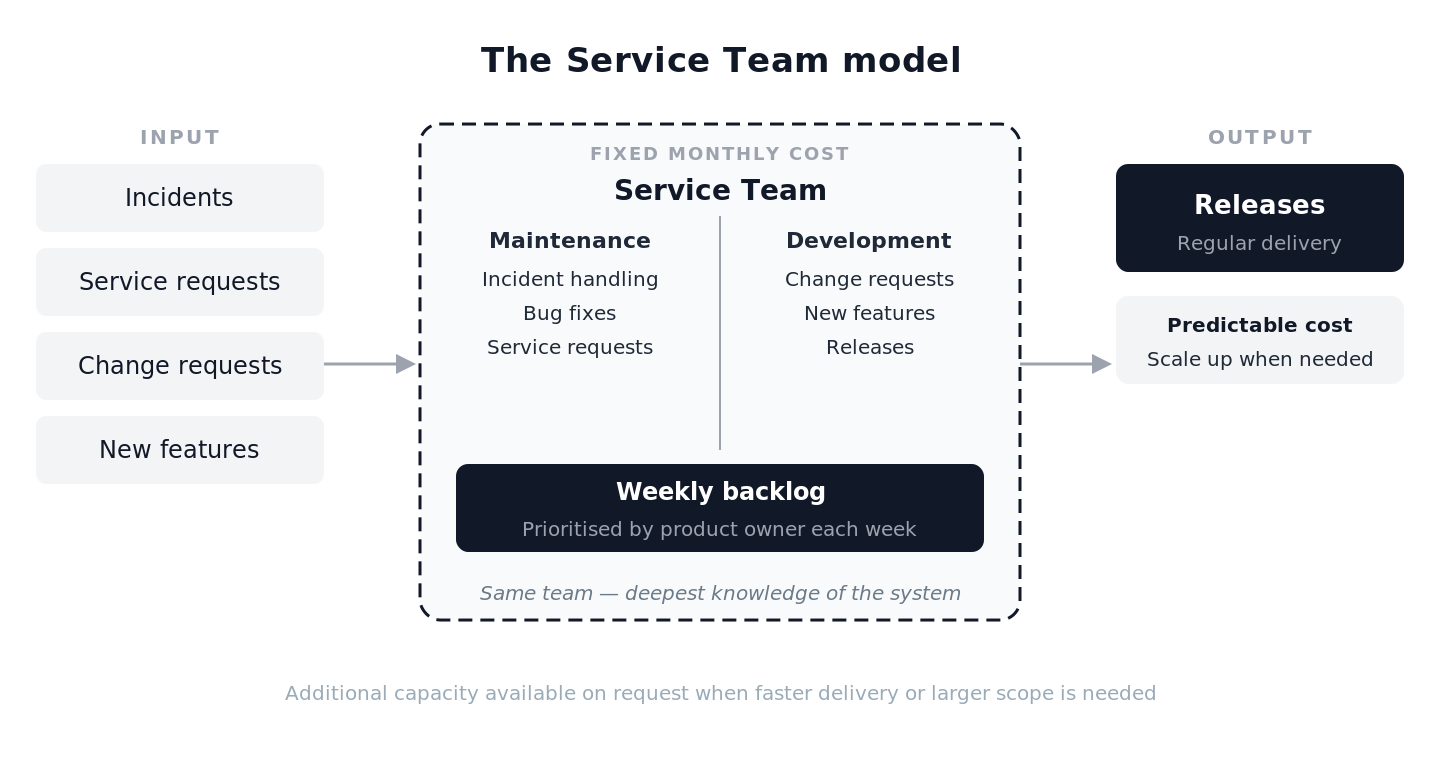
Within that fixed cost, Diaverum had access to a defined level of service and a capacity for new development. When faster delivery or additional resources were needed, Diaverum could place top-up orders. The product owner prioritised a shared backlog each week, covering both maintenance tasks and new features. Because the same team was responsible for both, the people working on new development were also the people who knew the existing system best.
This gave Diaverum predictable costs, continuous access to the team with the deepest knowledge of the platform, and the ability to scale up when business priorities required it.
The result
The platform was delivered on time and within budget. It met regulatory requirements across all targeted countries and received sign-off from the pilot clinics before roll-out. A support organisation and roll-out project were established as part of the delivery.
The Service Team model has provided Diaverum with a stable, cost-predictable model for maintaining and evolving the platform since go-live. The development team itself worked across five countries and time zones, a structure covered in more detail in Five countries, one development team.