
What we do

Business-critical projects must be predictable in terms of cost, time and result. That demands the right competence at every stage of the lifecycle, and a clear picture of what the system must do before a line of code is written.

Development

Backend · Frontend · Mobile

Senior developers across the full stack. We cover both product development and long-term maintenance across a broad range of languages, platforms and environments.

Architecture

System Architect · Solution Architect · Integration Architect

Architects who design the technical structure of individual systems and the integration architecture across enterprise landscapes. The role that determines whether a solution will scale, perform and hold up when complexity increases.

Project Management

Program Manager · Project Manager

Project managers with solid experience across waterfall, Scrum, SAFe and Kanban. We match the methodology to what the project actually needs, not the other way around.

Deployment & Rollout

Deployment Manager · Rollout Manager

Deployment managers who handle the transition from development to live, where most problems surface. Rollout managers who coordinate delivery across sites, teams and markets.

Quality & Process

Test Manager · Test Automation · Business Analyst · Configuration Manager

Test managers who define what done looks like and validate it before release. Business analysts who turn ambiguous briefs into specifications development can build from. Test automation specialists and configuration managers who maintain traceability and quality across the full lifecycle.

Infrastructure & Operations

DevOps · Infrastructure Engineer

Engineers who build and maintain the environments that software runs on. CI/CD pipelines, container platforms, infrastructure automation and operational monitoring. The work that keeps development and operations moving together.

Long-term delivery

Many of IT informa’s assignments are long-running. After a system is delivered, the work of maintaining and evolving it continues, often for years. For that phase, IT informa offers a structured model called the Service Team.

A Service Team covers both maintenance and new development under a fixed monthly cost. The product owner prioritises a shared backlog each week, spanning incidents, service requests, change requests and new features. Because the same team is responsible for both, the people working on new development are also the people who know the existing system best. When business priorities require faster delivery or larger scope, additional capacity is available.
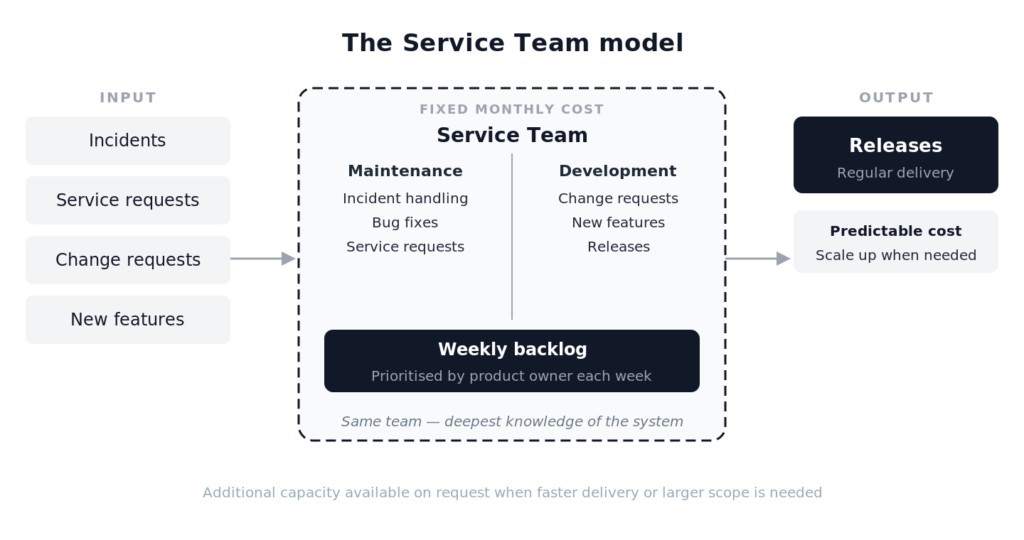
Diagram of the Service Team model: incidents, service requests, change requests and new features feed into one fixed-cost team handling both maintenance and development from a shared weekly backlog, producing regular releases and predictable costs.

Our approach

Non-functional requirements rarely appear in full on the spec. Availability, performance, maintainability, security and legal compliance are often stated in a single line, but each can account for a significant portion of the project budget if not identified and priced from the start. We work through these requirements systematically before they become unplanned costs.

Business-critical systems leave no room for assumptions. Quality must be precisely defined and thoroughly validated before any release.

We work transparently across all four dimensions of a business-critical system: the information it handles, the technology it runs on, the processes it supports and the people involved. When a client can see what is happening across all four, they can act on it. When they cannot, they cannot.
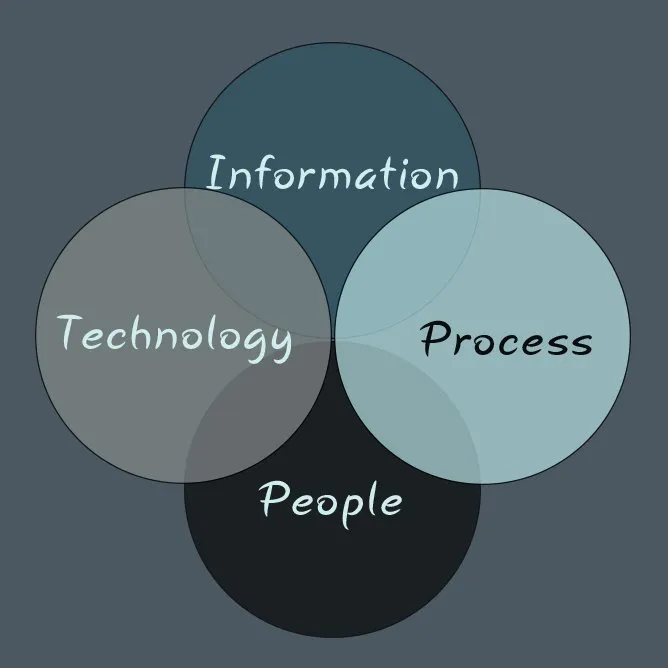
Four overlapping circles representing Information, Technology, Process and People as interconnected elements of the working process.
It’s a lot easier to change things you can see and measure. Working in a glass box is a great thing for both suppliers and customers.
Scroll to Top