
A case management system for Missing People Sweden
How a structured, GDPR-compliant platform replaced ad hoc processes for an organisation handling 600 missing person cases a year
Missing People Sweden (MPS) organises the search for missing persons across Sweden. Working alongside police and relatives, the organisation publishes missing person notices and coordinates search parties. Around 8,000 people disappear in Sweden each year; MPS handles approximately 600 cases a year, many involving organised search operations. The organisation has operated under Swedish Fundraising Control since 2017 and is funded by sponsors.
Each case involves sensitive information about the missing person, their relatives, the police investigation, and the search parties involved. Getting the right information to the right people quickly has a direct bearing on outcomes.
The challenge
Until 2018, the information flows supporting each case were largely unstructured. Search teams communicated through closed Facebook groups, and sensitive information was shared by phone. As the organisation grew and the General Data Protection Regulation came into force, this approach could not continue.
MPS needed to address several things at once: data quality, information security, accessibility across regions, consistent processes, and full compliance with GDPR. The organisation needed a case management system that could structure how cases were opened, documented and progressed, while maintaining the trust of the police and other partners who relied on MPS to handle sensitive data correctly.
The approach
IT informa proposed EasyFP, a solution built on the Easy Redmine open-source platform, configured around MPS’s specific case flow. Working with MPS volunteers, IT informa designed the information acquisition flows and configured the platform to reflect how cases actually progress.
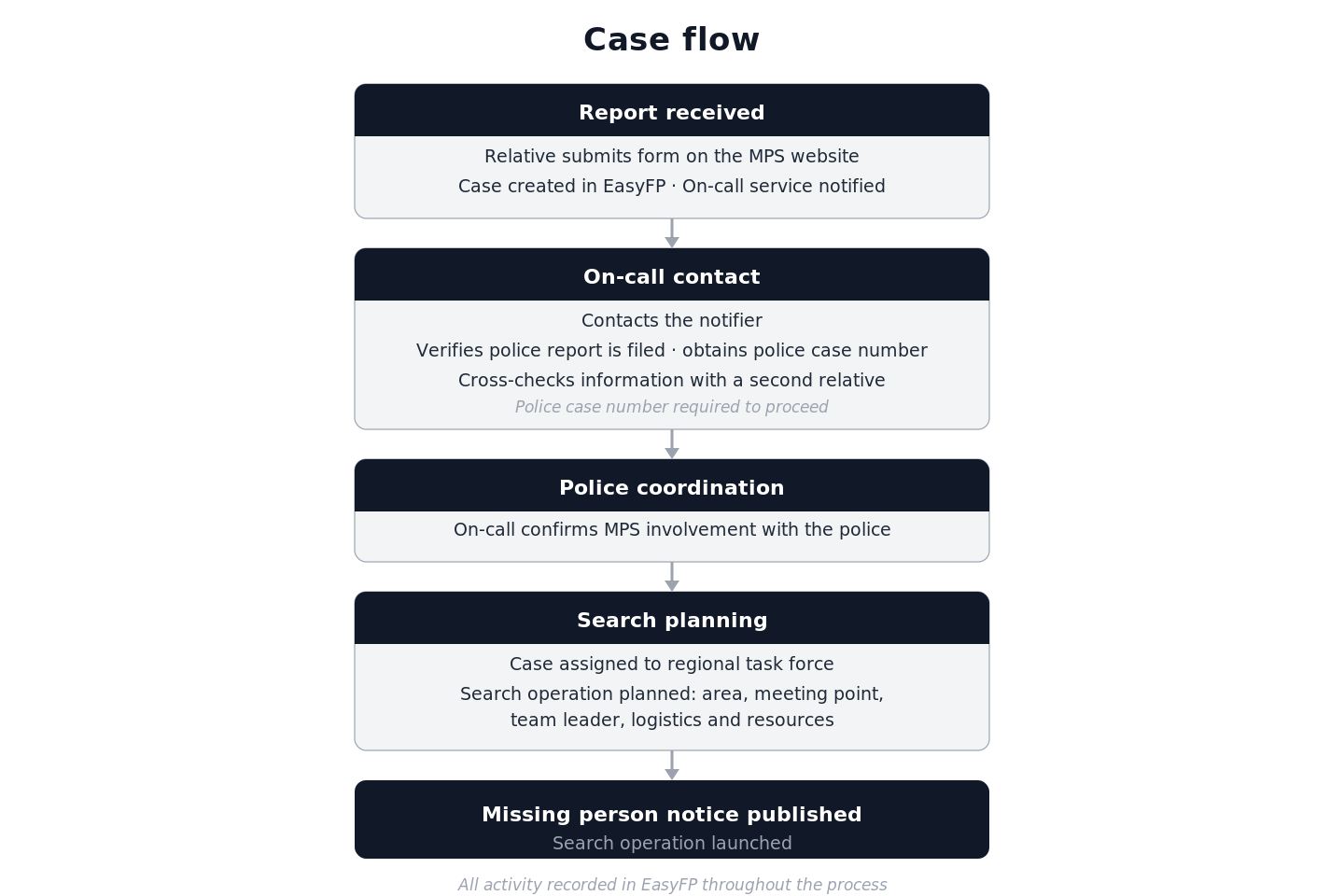
Each case is opened when a relative submits a form on the MPS website. This automatically creates a case record in EasyFP and notifies the on-call service. The on-call team contacts the notifier, verifies that a police report has been filed, and obtains the police case number, a prerequisite for proceeding. Information is then cross-checked with a second relative to ensure its accuracy. The on-call team also contacts the police directly to confirm MPS involvement in the case.
Each case record is structured as a set of tabs covering the missing person, next of kin, police liaison, and other areas as required. Each tab and field is permission-controlled, so only authorised individuals can access the information relevant to their role.
Once coordination is complete, the case is assigned to the regional task force. Drawing on local knowledge of the search area, meeting points, infrastructure and available resources, the task force plans the search operation. A missing person notice is then published, and the search is launched. Everything is documented in EasyFP throughout. The system also produces statistics that support internal planning.
The result
With every case handled through a single system, MPS gained control over its data that the previous approach could not provide. Information reaches the right people faster and through appropriate channels. The trust that police and other partners place in MPS has been strengthened by the organisation’s ability to handle sensitive personal data correctly.
Lead times to action have shortened. When the right people can access the right information at the right time, the chances of a positive outcome improve.