
A global customs compliance transformation for a major international retailer
A five-year programme replacing a custom-built global customs system with a commercial platform, with IT informa supporting requirements, implementation and business adoption throughout
Global retail at scale means global supply chains, and global supply chains mean customs. Compliance with customs regulations determines what can be sold, in which markets, at what price, and whether deliveries can proceed. For a retailer operating across multiple continents, the systems that manage this are not peripheral. They are central to business continuity.
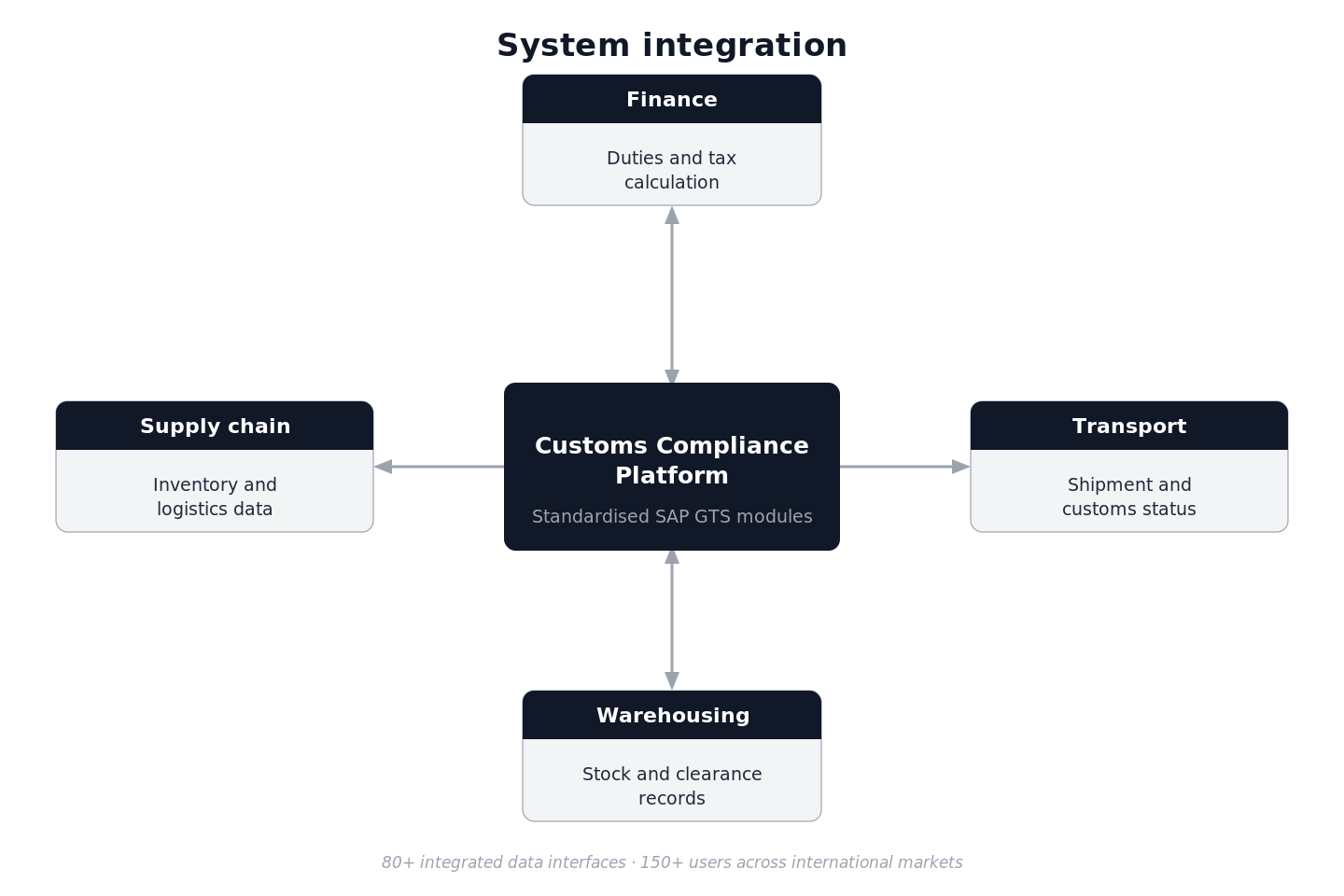
When a major international retailer decided to replace its existing customs compliance platform, the programme covered more than 80 integrated data interfaces, more than 500 users across international markets, and complex workflows spanning supply chain, finance, transport and warehousing. IT informa provided consultants in key roles on the business side of the programme throughout its lifecycle, covering requirements management, test management, implementation support, rollout and business adoption.
The challenge
The organisation had built its own customs system over many years. As it aged, the question became whether to continue developing it or move to a commercial platform. An extensive pre-study examined both paths, and the business case for a commercial solution proved the stronger choice. The decision was made to replace the custom-built system with SAP GTS.
Replacing a business-critical customs system is not a straightforward transition. Customs and trade operations had to remain functional throughout the programme. A failure in compliance does not just create a regulatory problem: it halts deliveries. The existing system carried years of embedded business logic and local market adaptations, all of which had to be understood, mapped and re-established in the new platform before any cutover could take place.
The scope was broad. More than 20 integrated systems needed to be aligned across multiple business domains. Workflows covered more than 80 process areas. Stakeholders from more than 15 business units needed to be engaged and aligned on requirements. The programme had direct implications for pricing, product range and profitability across the retailer’s markets: a change that touched the core of the commercial operation.
The approach
An external vendor was responsible for the SAP implementation. IT informa’s role was in the business programme alongside it: ensuring the organisation’s requirements were captured and translated into the platform, that the solution was structured correctly for the business, and that it landed well with the teams and markets that would use it.
Multiple Scrum teams operated in parallel, coordinated through a Scrum of Scrums model to manage cross-team dependencies. Other parts of the programme ran on waterfall frameworks alongside agile workstreams, reflecting the mix of supplier contracts and organisational structures involved.
IT informa consultants covered requirements structuring and traceability across parallel Scrum teams, fit-gap analysis between the business processes and the SAP platform, product backlog management, integration design across more than 20 systems in supply chain, finance, transport and warehousing, test leadership across more than 80 integrations, and programme management and rollout coordination. Stakeholders from more than 15 business units were aligned on requirements throughout.
The result
The new customs solution was implemented and deployed globally. Following rollout, the solution was handed over to line-of-business operations after a defined hyper care period, ensuring the receiving organisation had full ownership and support capability in place. The platform serves more than 150 users across international markets and is now the organisation’s standard for customs compliance operations.
The programme ran across five years, covering the full lifecycle from early requirements work and architecture through implementation, testing and deployment. IT informa contributed consultants at every stage, adapting the roles and capacity to what the programme needed at each point. Alongside the programme roles, IT informa also had a consultant embedded in the line-of-business organisation, supporting the business directly throughout the transition.