
Building a production management system for a global packaging manufacturer
A 50-person project that delivered a real-time factory system now running around the clock across 25 sites
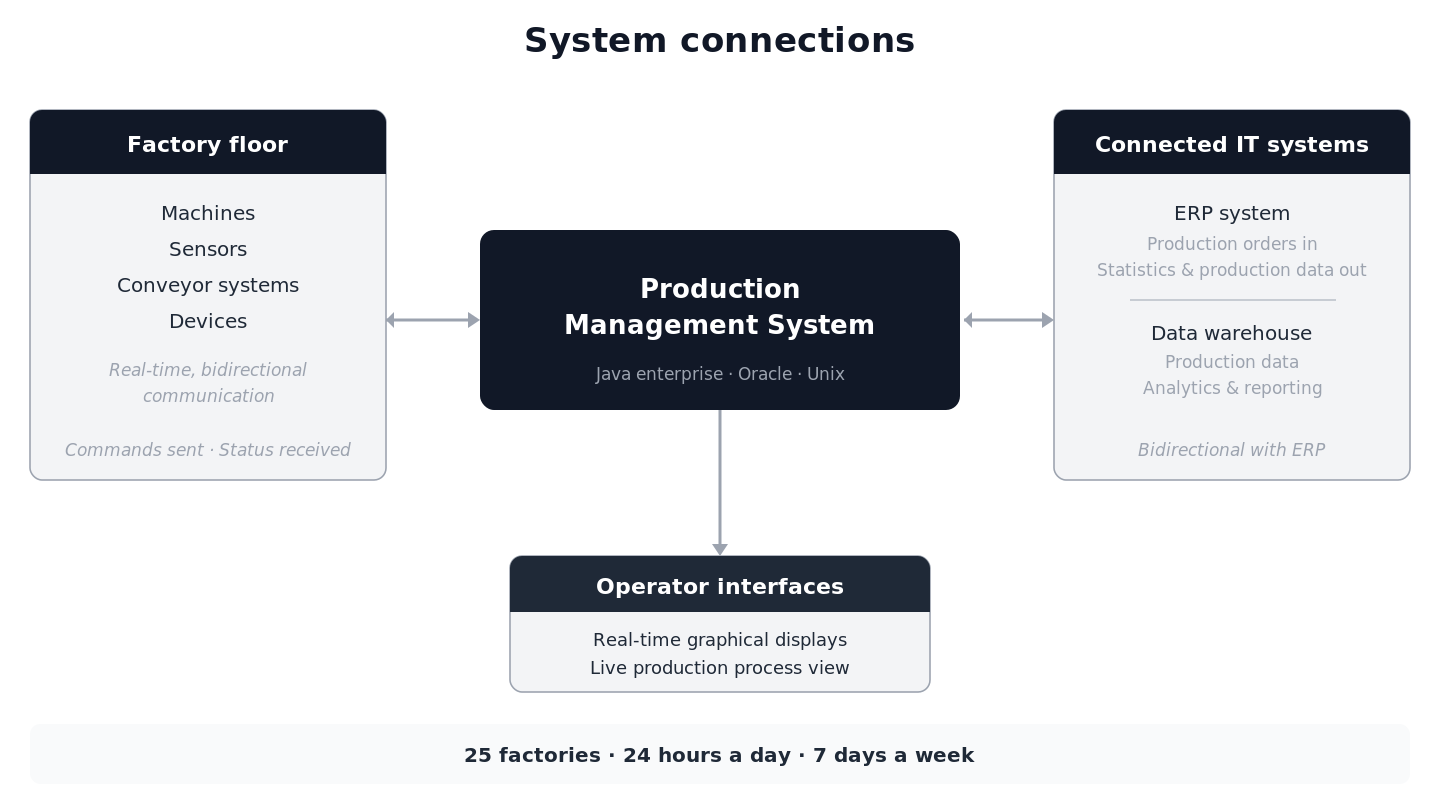
A global manufacturer of food processing and packaging solutions runs factories across multiple continents. Each factory’s manufacturing process is managed by a dedicated production system: it receives orders from the ERP system, drives and monitors the machinery on the factory floor, and returns production data and statistics. The system is in operation around the clock, every day of the year. A lost production hour cannot be recovered. When the system is unavailable, deliveries to customers are delayed by the same amount.
When the manufacturer decided to replace the existing production system with a new one built on a modern technical platform, it was one of the most demanding development projects the organisation had undertaken. IT informa provided consultants in key roles across the project.
The challenge
The scope covered the full lifecycle of the new system: analysis of the existing system in close cooperation with the business, establishment of development processes and organisation, development and verification of the new system, and pilot and handover to both the business and the application maintenance organisation.
The system itself set demanding technical requirements. It needed real-time communication with machines, sensors and devices on the factory floor, and highly graphical interfaces displaying the ongoing process as it happened. The information model was complex, with significant data volumes and integrations spanning ERP systems, data warehouses, conveyor systems and other factory equipment. Very high requirements on performance and availability applied throughout: any degradation in performance has immediate operational consequences.
The approach
The project was organised into ten workstreams at the outset, covering project management, business and requirements analysis, system architecture, application development, project infrastructure, test and pilot. Around 50 people were involved in total, a mix of the client’s own staff, IT informa consultants and other external expertise.
After the architecture had been established, the requirements baselined and the development and deployment process verified, the project moved into a more intensive development phase. This was structured as what the team called a software development factory: four development teams, each mentored by an architect from a shared architecture forum. The architects did not only review. They actively guided each team through the decisions that mattered for maintainability, performance and correctness.
Design patterns, code reviews and mentoring were applied consistently across all parts of the system. Automation covered testing, build, deployment and documentation, reducing manual overhead and keeping quality checks in the process rather than at the end of it.
The result
The system was approved by the pilot factory and subsequently rolled out to over 25 factories across the client’s global manufacturing network. The project closed on time and within budget. A support organisation and ongoing development process were established as part of the delivery, along with new infrastructure for development and deployment.
The system runs around the clock, every day, across all sites.